I was recently driving through the Valle d’Itria just before sunset. The light was extraordinary. Lush vineyards embraced by dry stone walls. Trulli appeared around every bend, and every few minutes I wanted to stop.
But there was nowhere to stop.
No small viewpoint. No shaded bench. No lay-by designed to let people pause and appreciate one of Italy’s most beautiful landscapes. I kept driving.
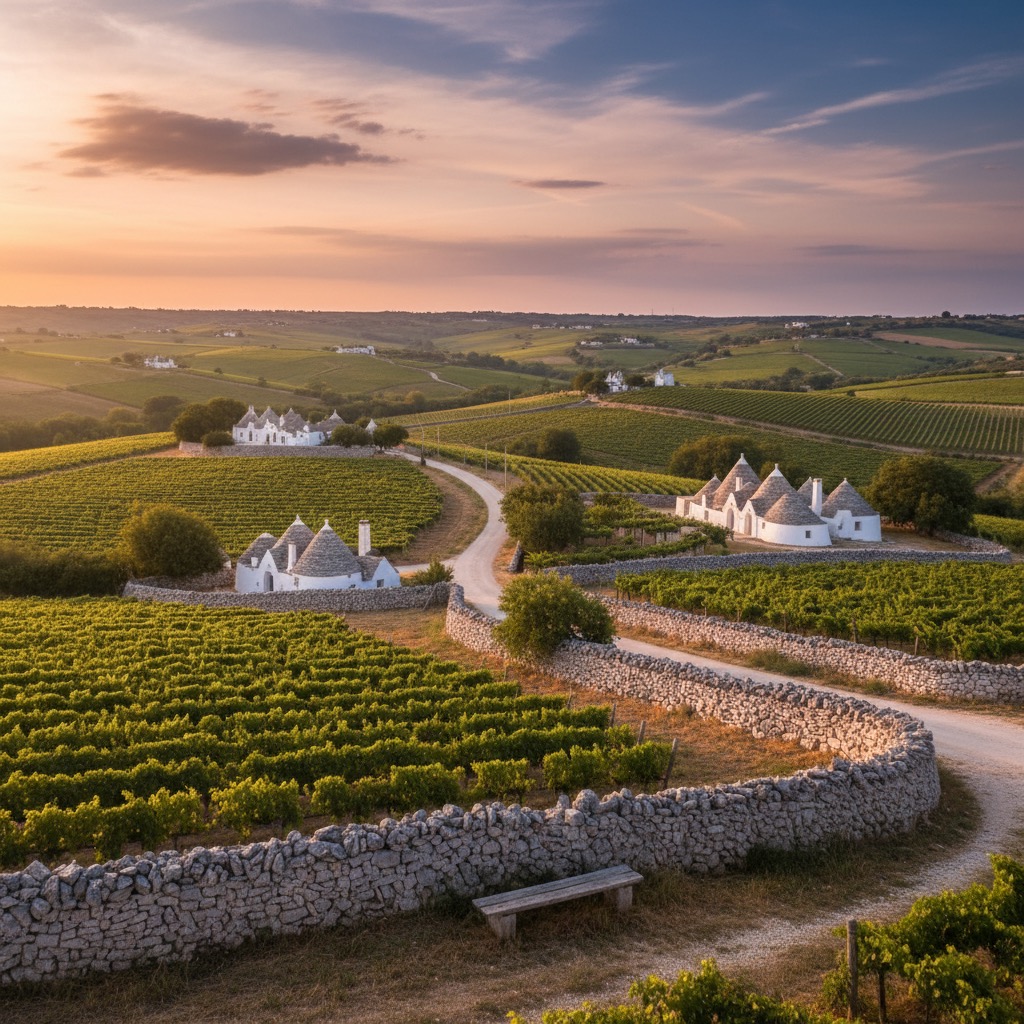
And somewhere between Locorotondo and Martina Franca I found myself wondering something that had nothing to do with roads. Who looks after beauty once it belongs to everyone? That question stayed with me long after I got home.
The Valle d’Itria isn’t unique. The same pattern appears hundreds of kilometers away in Lecce.
In the Baroque capital of Lecce, there is a bench in a local park where three elderly women gather every evening – not because the bench welcomes them – its slats are cracked, its paint long gone – but because it is the only bench there is. In front of them, a cement flowerbed hangs on to crunchy weeds burned by the sun, only compacted earth and a cigarette packet. Twenty meters away, a new street of private villas gleams: bougainvillea trained over modern stone, swept twice a week. The border between the two worlds is a kerb.
Puglia is one of the most photographed regions in Europe. The coastline, the borghi, and the masserie fill magazine covers and wedding albums. And yet the spaces we actually share – the piazza, the roadside, the town entrance, the public bench – too often look like nobody’s responsibility. Maybe there are planning reasons I don’t understand. Maybe budgets are impossibly tight. But I can’t shake the feeling that these landscapes – and cityscapes – deserve places where people could pause and appreciate. The question is worth asking plainly: who cares for public beauty?
The gap nobody planned
The neglect is not a mystery and it is not, mostly, a moral failing. Walk into people’s homes and they’re immaculate. Step outside the front gate and it’s another story. The contrast is striking. Private care ends exactly where public responsibility begins. Whether this stems from habit, incentives or decades of underfunded municipalities, the result is the same.
Public beauty falls into an administrative void. Municipalities are underfunded and triage accordingly: roads before flowerbeds, pipes before benches. Private businesses, even those whose livelihoods depend entirely on Puglia looking like Puglia, have no obvious channel through which to contribute – and little incentive when they find one. Citizens, reasonably, assume it is the state’s job. The result is a region that is breathtaking in the aggregate and shabby in the particulars.
The answer is not simply “more public money,” because there will never be enough, and not “privatization,” because a piazza that belongs to a brand is no longer a piazza. The answer is shared stewardship: beauty as something co-maintained by public bodies, private actors and citizens – with visible accountability attached to every contribution.
Italy already rewards patronage. Just not this kind.
Here is the strange part: Italy already has one of Europe’s most generous cultural patronage schemes. The Art Bonus, introduced in 2014 and made permanent in 2016, gives donors a 65% tax credit for cash contributions to public cultural heritage.
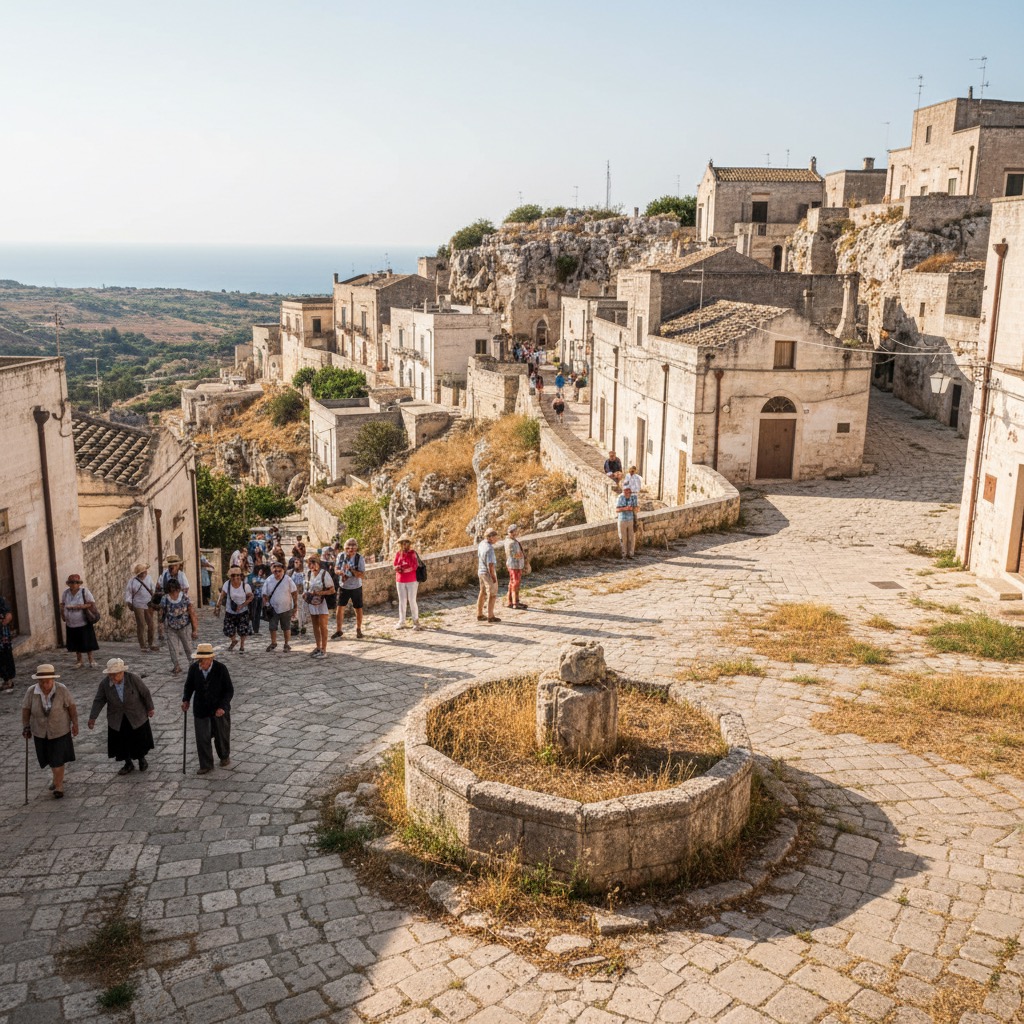
But look at what qualifies: the asset must be formally recognised by the Ministry of Culture as a bene di interesse culturale – a monument, a museum, a theatre, an archaeological park. Donations to anything privately owned are excluded entirely. And so, by definition, is almost everything that makes up the everyday public realm: the ordinary piazza, the bench, the row of trees along a viale, the flowerbed at the town entrance, the panoramic pull-off that doesn’t exist yet.
The asymmetry is absurd when you state it plainly: the Italian state will refund 65 cents on the euro to restore a monument, and next to nothing to plant a tree in front of it. Everyday beauty is routed instead into municipal sponsorship contracts – worthy, but treated as ordinary business expense, negotiated town by town, and invisible to most of the enterprises that might participate.
In the land where Dolce & Gabbana, Gucci, Prada, and Armani were born, how can it be that these public places are left behind? I have the same question regarding the schools in the south but that’s another topic.
So here is my open question: why don’t they extend the Art Bonus logic to decoro urbano? Call it a Bonus Bellezza. A meaningful tax credit for verified donations to public green space, street furniture, and shared civic spaces – administered through the same public platform, with the same transparency, as the Art Bonus itself.
Bari has the blueprint.
The second strange part: the model already exists in Puglia – in one city. The Comune di Bari runs an adoption programme for public green areas that lets citizens, condominiums, schools, associations and businesses take on the maintenance and improvement of flowerbeds, gardens and parks. The regulation was deliberately streamlined in 2021 to cut bureaucracy; adopters may post a modest sign acknowledging their care, exempt from the advertising tax, and any profit-making use is excluded. Bari has run similar sponsorships for roundabouts, landscaped and maintained by private sponsors for a set term. It works. And it stops at the city limits.
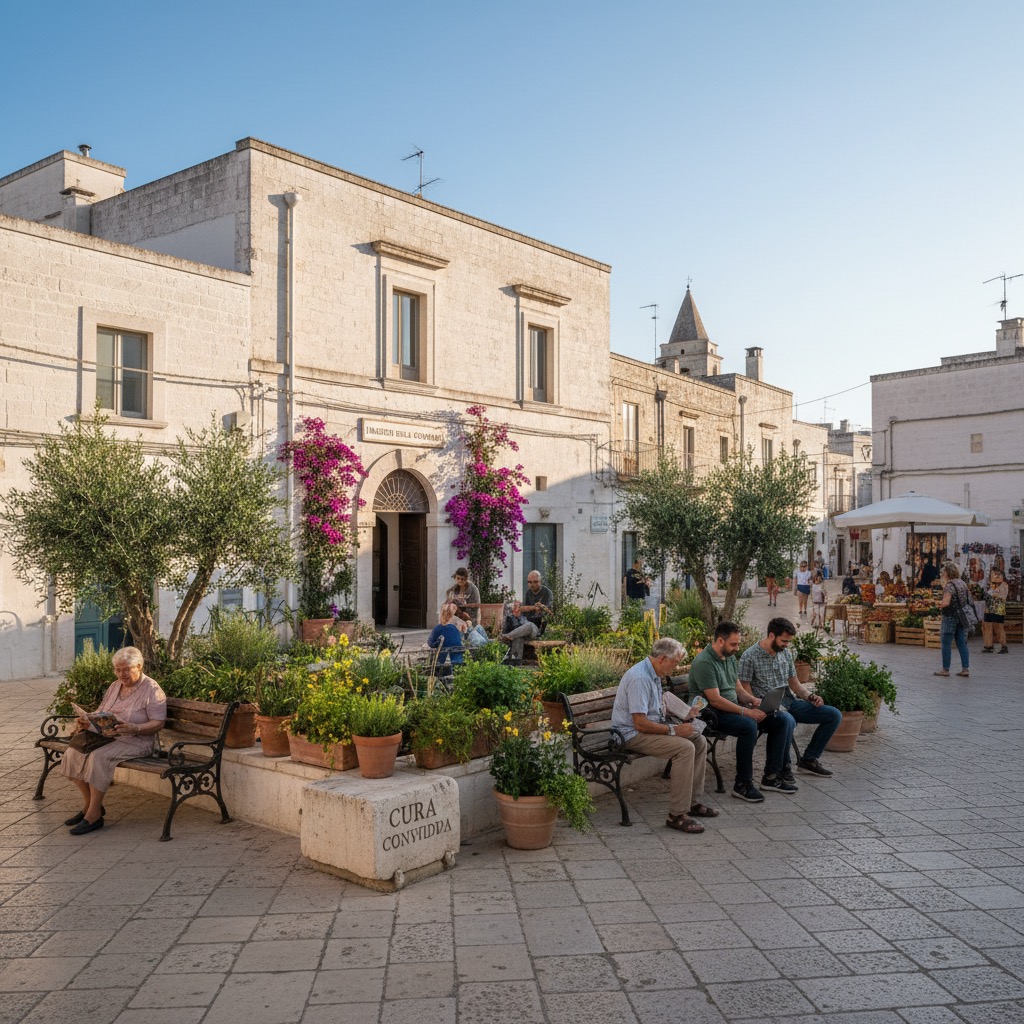
Brindisi, Lecce and a hundred small towns that are the true face of the region don’t really follow. Some towns have a regulation gathering dust; most have nothing; almost none publicize what exists. A bar owner in Ostuni or a wine producer in Salento who wanted to adopt the piazza outside their door would first have to discover whether their comune allows it, then navigate a procedure invented locally, then accept that the fiscal recognition for their generosity is close to zero.
Puglia does not need a new idea. It needs to scale one it already has: a single regional framework – one regulation, one online registry of adoptable spaces, one standard convention, one plaque design – so that adopting a flowerbed in Cisternino is exactly as easy as in Bari, and so that every act of stewardship is public, searchable and accountable.
The road is a public space too
Stewardship should not end at the piazza. Anyone who has driven the coast between Monopoli and Otranto, or crossed the Valle d’Itria at golden hour, knows that Puglia’s roads pass through some of the most photogenic country in the Mediterranean – and offer almost nowhere safe or dignified to stop. Visitors pull onto gravel verges to photograph a trullo. Drivers with kids and elderly travellers drive an hour without a shaded rest area.
France turned its motorway aires into a point of national pride; Norway commissioned architects to build scenic-route viewpoints that became destinations in themselves. Puglia could do a modest version through the same stewardship logic: panoramic pull-offs and rest stops adopted and maintained by local enterprises – an olive oil consortium, a hotel group, a bank foundation – each with seating, shade, and a small credit to its steward. In this way, the road stops being a corridor and becomes part of the experience it passes through.
The same goes for legibility. Andria and Trani mark their historic centres with the clear, consistent signage familiar across Italy and Europe. Many Apulian towns of equal beauty announce themselves with nothing at all. Uniform historic-town signage is the cheapest item on this entire list – which makes its absence the most telling.
What Four Seasons should have learned – and what its critics are owed
If you want proof that stewardship is not decoration but social contract, look at Ostuni. The Four Seasons Costa Merlata project – a roughly €100 million resort of 49 buildings on nine hectares of protected rural coastline – has become one of the most contested developments in recent Apulian memory. The superintendent warned of irreversible alteration of the coastal landscape; the project was pushed through anyway via a special economic zone authorization in late 2025; environmental associations took it to the regional court; and the Puglia Region itself has now joined the legal battle against it.
Let me be careful here, because the point is easy to get wrong. The opposition to the Mogale company includes substantive objections – soil consumption, landscape protections, the integrity of a coastline dotted with caves, dunes and migratory bird habitat – and no number of donated benches would answer them. Stewardship is not a licence to build.
But the animosity – the sense of a luxury enclave extracting value from a commons and offering nothing back – is precisely what a stewardship culture changes. Imagine the same investors arriving with a different posture: a restored public coastal path, a funded belvedere open to everyone, a maintenance endowment for the surrounding rural landscape – all registered, all accountable, before permission was sought rather than after opposition arose.
The environmental questions would remain, as they should. But the conversation would have been about partnership with a place, not colonization of it. In a region where every future investor is watching how this ends, that distinction is worth billions.
Accountability is what separates stewardship from greenwashing
None of this works as a branding exercise, and the fastest way to kill public trust in it would be to let it become one. So the conditions matter as much as the incentives.
A public regional registry of who has adopted what, updated and searchable by any citizen. Commitments to maintenance, not just installation – three-year minimums, as the best municipal schemes already require. Sunset clauses: neglect your adopted space and you lose it, publicly, with restoration costs charged back. Discreet acknowledgment – a plaque, not a billboard; patronage in the tradition of the guilds and families who gave this region its fountains and facades, not advertising with a civic veneer. Shared stewardship means shared responsibility, on the record.
Who cares for public beauty?
Today the honest answer is: nobody in particular – and it shows on every cracked bench and bare flowerbed between here and Santa Maria di Leuca. But the pieces of a better answer already exist. A national tax instrument that needs one extension. A municipal model that needs one regional framework. A business community that lives off this region’s image and has never been properly invited to maintain it. And a cautionary tale on the coast of Ostuni about what happens when private ambition arrives without a gift in hand.
The answer to the question should be: all of us – visibly, gladly, and on the record. The region that taught the world what beauty looks like can teach it who beauty belongs to. If we want Puglia to remain one of the world’s most beautiful regions, beauty cannot be treated as a product. It has to be treated as shared infrastructure.